Notes on: Milbrandt M. et Al (2004). Teaching to Learn: A Constructivist Approach to Shared Responsibility. Art Education, 57 (5), 19-33.
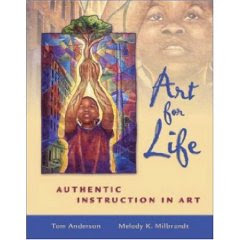
“Student decision-making has undoubtedly been the crux of creative and critical thinking and is central to a humanistic approach to art education (Lowenfeld & Brittain, 1970; Eisner, 1972; Gaitskell & E Hurwitz, 1975). Issues of choice and voice are also central to contemporary art education (Chalmers, 1992; Efland, Freedman, & Stuhr, 1996; Gaudelius & Speirs, 2003; Barakett & Sacca, 2003; Sullivan, 2003, Anderson & Milbrandt, 2004), and are, essential in the processes of analysis, interpretation, and the construction of meaning for students as they look at art (Anderson, 1995; Barrett, 2000).”
“King (1983) suggests that self-determination or choice is a powerful motivational force in learning that simultaneously enhances both achievement and attitudes about learning. Yet with the current emphasis on educational accountability, teachers sometimes find it increasingly difficult to step out of their roles as educational gatekeepers and allow students a greater sense of agency and voice in their own learning.”
Constructing Learning
“…constructivists view knowledge as constructed by the learner in a particular context, and not pre-existent or given from an expert or authority.”
“Yet in the daily lives of teachers in K-12 classrooms where a modernist paradigm typically prevails, a continual emphasis is placed on teacher accountability and on student acquisition of established knowledge.”
What is Constructivist Theory?
“…at the heart of the constructivist approach to education is the understanding that students are in control of their own learning.”
“Phillips (1995) identifies three distinct student roles in constructivism. These roles are described as the active learner, the social learner, and the creative learner.”
“The creation of meaningful artwork involves the student in a construction of identity through purposeful and expressive visual language (Anderson & Milbrandt, 2004).”
“Learning embedded in social interactions in which students discuss, debate, investigate, and explore multiple viewpoints rather than accept the teacher's viewpoint as the only authority offer other powerful avenues for active art learning and connect students to the real world beyond the classroom.”
“From a constructivist viewpoint, knowledge and understanding are created or recreated; it is not enough for the student to be only actively involved in producing artwork. Structuring purpose and meaning should be at the heart of artistic activity.”
“Both Dewey and Piaget suggest that motivation for the construction of knowledge often comes from an experience of cognitive conflict or puzzlement.”
“As creative learners, students often experience a synthesis of personal or established knowledge during problem solving that continually produces a change or shift in cognitive structures. Because knowledge is authentically acquired both in the classroom and beyond, students need to build structures of cognition that accommodate and assimilate fragmented knowledge into previously acquired understandings-a process Efland and others have termed flexible cognition (Efland, 2002).”
“Chandra and Basinger (2000) utilize art history constructivist inquiry methods to engage elementary students in the development of contextual understandings of African artworks.”
“Participation in an in-depth rigorous analysis of artifacts from multiple viewpoints involves students in a more integrated and richer view of the world that more closely simulates realworld problem solving than does traditional classroom instruction (Windschitl, 2000; Scherer, 1999).”
“Through critical discussions about art, students are challenged to consider crucial human questions regarding cultural images of what is true, beautiful, and moral (Scherer, 1999) and to construct or re-construct their own understandings and values.”
“The analysis, interpretation, and production of artworks engages students in many opportunities for decision-making as well as critical and creative thinking (Hamblen, 1984).”
“For many teachers, balancing the increased demands of accountability and high performance standards with student interests and needs for self-determination becomes a high priority (Anderson & Milbrandt, 2004).”
Sharing the Responsibility
“In the spring of 2003, three Atlanta area high school art teachers implemented constructivist lessons to see how students would accept responsibility for their own learning and peer-teaching situations.”
“Led by these teachers, students generated their own lesson objectives and evaluation criteria.”
“Because the students wrote their own objectives, during the duration of the project there was little question about the intended lesson outcomes.”
“Compared to her past printmaking experiences, Abghari observed that these students seemed to work faster during this unit and accomplished more work in fewer periods. The students were more involved and engaged with their learning and worked much more independently.”
“This interaction among students seemed to build greater sensitivity and understanding of each other, as well as greater regard for one another's artwork.”
“The ongoing art historical and art critical discussions created a more holistic learning experience that also facilitated ongoing critical dialogue throughout the production phase of the lesson.”
“Many brought unsolicited related Internet articles to the class discussion and made stylistic and conceptual connections to their artwork-in-progress.”
“One of the major criticisms of constructivist theory and practice is that when students structure their own learning the result is trivial rather than rigorous (Brooks & Grennon Brooks, 1999). Others critics suggest constructivist methods only work with older, very mature students.”
“The teachers agree that as the students became more personally invested and empowered through their work they demonstrated higher levels of critical thinking in their remarks and interactions.”
The Teacher's Role
“These teachers facilitated a framework with components similar to those suggested by Dever and Hobbs (2000) in which students actively engage, investigate, share, and assess their own performance.”
“Within each lesson, teachers prepared a baseline of introductory information, but encouraged students to determine where they wanted the learning to take them and the level of performance they would attain.”
“While constructivist lessons are typically more student-centered than traditional lessons, the role of the teacher-as-facilitator is critical to student success.”
Guidelines for Successful Constructivist Teaching
“Provide students with a variety of tools for research (i.e. Internet sites, digital cameras, books, and maps) so students become the primary research investigators.”
“Frame strategies for several large and small group collaborations to foster peer support and interaction.”
“Develop a flexible classroom climate that encourages student inquiry and discussion.”
“Present numerous opportunities throughout the lesson for students to make individual choices about their artwork.”
“Negotiate lesson objectives and evaluation criteria with students.”
“Encourage students to create real world and cross-disciplinary connections that extend beyond the classroom. Help students construct a vision for their future, a purpose for learning, cross-disciplinary connections, and personal meaning in their work.”
“Act as a participant-facilitator in the teaching-learning process, rather than as an authoritarian who dispenses knowledge.”
“Encourage students to take ownership of their learning, develop expertise, and share their knowledge with others.”
“Rather than planning a lesson in which the teacher directs a classroom of students in one general pre-determined direction, the constructivist approach facilitates the movement of student learning in multiple directions.”
“It is important for teachers to develop a supportive network among other teachers who share a common interest in constructivist teaching and learning.”
“The development of a stronger student voice in learning does not diminish the teacher's role, standards, or outcomes, but rather encourages students to construct their own views, explore their own interests, engage their own passions, and create newly empowered visions of self and learning in a supportive community.”

DBAE vs. TAB
DBAE (Discipline-Based Art Education) Verses TAB (Teaching for Artistic Behavior):
Two Approaches to Art Education
Joni H. Hough
University of North Carolina at Charlotte
ARTE 5121
Dr. David Gall
December 10, 2009
Discipline-based art education (DBAE) has been the leading framework for art education for the past twenty-five years. According to Day (as cited in Stankiewicz, 2000),
…the discipline-based approach has influenced the National Standards for Arts Education, the framework for the recent National Assessment of Educational Progress in the arts, the National Board for Professional Teaching Standards guidelines for art certification, as well as state art guidelines, district art programs, and the art teaching of many individuals (p. 311).
Teaching for Artistic Behavior (TAB) is a choice-based approach to art education (http://teachingforartisticbehavior.org/, 2009). This paper will compare and contrast these two methods to art education.
In 1982, the J. Paul Getty Trust established the Getty Center for Education in the Arts (Duke, 1988). According to Duke (1988), “Unlike a grant-making foundation, which funds the programs of others, the primary purpose of the Getty is to create and operate its own programs” (p. 7). “By the mid 1980s, the Getty Center for Education in the Arts…became a major catalyst for reform in art education” (Delacruz & Dunn, 1995, p. 46). Duke (1988) states,
The Center found that the status of art education had declined alarmingly. Most students spend 12 years in school during which they receive some 12,000 hours of instruction in all subjects. Less than one percent of this time is spent in studying any of the art forms, and 80 percent of all students who graduate from public high schools have little, if any, instruction in the arts at all... Moreover, arts instruction in many places has been limited to teaching technical skills for making art - not to teaching students about the historical and critical aspects of art as well. While studio-oriented art may have been a satisfying experience for a few innately gifted students, it meant that children were not receiving sufficient instruction in the cultural and historical contributions of art or in how to analyze, interpret, and value works of art (p. 7).
DBAE became the art program championed by the Getty Center for Education in the Arts. DBAE had the full weight of the Getty Center for Education in the Arts behind it with programs for public advocacy, professional training, the creation of DBAE model programs, theoretical research, and curriculum (Duke, 1988).
Through DBAE, the Getty Center for Education in the Arts would change the face of art education. According to Delacruz and Dunn (1995),
In 1987, in the special Summer issue of the Journal of Aesthetic Education devoted to aspects of DBAE, Gilbert Clark, Michael Day, and Dwaine Greer boldly spelled out the theory of DBAE. According to Clark, Day, and Greer (1987) discipline-based art education draws content from four foundational disciplines-art studio, art history, art criticism, and aesthetics-as these disciplines are defined by a community of scholars and experts who have devoted themselves to inquiry in these fields of study. Formal written curricula in the visual arts should be developed for all grade levels within the school district. Curricula should be structured sequentially and hierarchically, and implemented on a district-wide basis. Student achievement and program effectiveness should be formally and systematically assessed and evaluated (p. 47).
DBAE elevated art education to a new status. It was now an actual discipline, with a testable curriculum. Hamblen (1987) maintains that, “The language of DBAE is one of a no-frills, no-nonsense program that leaves little doubt that budgeted money will be well-spent and that there will be no hedging on what needs to be done and what will be accomplished” (p. 69).
During the late 1980s and the early 1990s, DBAE flourished, but it was not without its critics. Hamblen (1987) states,
In my opinion these educational perspectives alone are not adequate to the needs of a pluralistic society undergoing rapid change and requiring a variety of types of input and a variety of view-points. These rationalistic perspectives do not allow for curriculum choices being problematic and open to dispute and challenge (p. 69).
Hamblen (1987) further condemns the art criticism aspect of DBAE, maintaining,
Considering, however, that children will be studying exemplars, this aspect of art criticism is also predetermined in that children will be asked to evaluate what has already been given validation by the learned. Focusing on what is deemed to represent the aesthetic heights of a culture could give students a distorted view of art and a view that has little resemblance to the world in which they live (p. 72).
Hamblen (1987) also points out,
If standardized testing becomes an overriding concern, lower cognitive levels can be expected to constitute much of the art curriculum. The metaphoric qualities of art, so integral to its understanding, will have little place in the identification and convergent responses required by objective test questions. Statements that art instruction should emulate other subject areas need to be assessed as to whether the dominant characteristics of general education, beyond their legitimating power, are desirable. It is in the area of the cognitive level of instruction occurring that the consequences of teacher-proof materials, predefined outcomes, and standardized testing could become all too evident (p. 75).
According to Stankiewicz (2000), “Although DBAE initially signaled attention to content, and was criticized for the other two components of art education – the learner and the social context” (p. 311).
The Getty Center for Education in the Arts did listen to some of DBAE’s critics. “In their attempt to accommodate diverse views about art education (and the vehement criticisms of DBAE in particular), the GCEA (Getty Center for Education in the Arts) found itself in the midst of the multicultural education movement” (Delacruz & Dunn, 1995, p. 47). Delacruz and Dunn also state,
Many of the participants attending the 1989 and 1992 Issues Seminars identified common aims for multicultural education and DBAE. Both movements recognized the need for programs of study that embrace ethnic diversity. Both movements recognized the need to identify, examine, and incorporate alternative ways of looking at art. Both movements recognize the need to address the problem of context: that is, the attempt to study artists, art forms, and cultures out of their original settings. And finally, both movements recognize that no single voice in the field ‘speaks for’ DBAE or multiculturalism (p. 48).
Although, the Getty Center for Education in the Arts did address the need for multicultural content to be added to the DBAE curriculum, there are still issues with some of the basic tenets of DBAE. For example, Stankiewicz (2000) points out,
Passive metaphors of learners receiving objectified knowledge from external authorities should be replaced by conceptions of the learner as an active agent, setting personal goals for learning, and creating meaning through encounters with art (Erickson, Katter, Lankford, Roucher, & Stewart, 1999). Both content and learner are structured by gender, ethnicity, class, and all the other cultural factors that contribute to the production and reproduction of shared values (p. 311).
It is in this area that TAB excels.
Whereas DBAE had financial and political support from the Getty Center for Education in the Arts, TAB is a grassroots organization that was formed for and by art teachers (Douglas & Jaquith, 2009). Although TAB is supported by Brown University, Massachusetts College of Art and Design, and Bridgewater State College, “…it remains an independent movement firmly planted in classroom practice” (Douglas & Jaquith, 2009, p. xii). According to teachingforartisticbehavior.org (2009),
The concept emerged over 30 years ago in Massachusetts classrooms through the need for more authentic art making experiences. United through Massachusetts College of Art (MassArt), teachers working in isolation discovered others who also held belief in the child as the artist. With the support of MassArt, NAEA and The Education Alliance at Brown University, the Teaching for Artistic Behavior Partnership (TAB) was formed in 2001 and incorporated in 2007 (http://teachingforartisticbehavior.org/).
According to Douglas (2007), students in a TAB classroom can work at their own pace, work from their strengths, follow a train of thought over time, learn from and work with peers, be “on task” for a greater portion of class time, develop a working style, explore their interests in visual form, form cooperative groups and engage in positive social interaction, and take responsibility for the care of materials and the classroom. Teachers in a TAB classroom can observe students working to determine strengths and weaknesses, work with small groups of interested students while others work independently, allowing for more in-depth instruction, offer special “scaffolding” to struggling students, get to know students through their personal styles, expect students to come to class highly motivated and ready to work (Douglas, 2007).
There are four practices that form the structure of choice-based art education. First, the student is the artist. Douglas and Jaquith (2009) maintain, “This powerful statement insures that students will have control over their subject matter, materials, and approach” (p. 9). The teacher presents a five minute demonstration of a new material, technique, or art concept at the beginning of each class, ensuring that content standards are met. After that, students choose at which studio center they will work.
The second practice is pedagogy. Douglas and Jaquith (2009) state,
Choice-based teaching comes in many forms: direct and indirect (through visuals and references), whole-group demonstrations and discussions, small groups with students who choose a particular exploration, and one-to-one interactions. These multiple approaches are possible because student independence is encouraged. Teacher roles include demonstrating, modeling, facilitating, caching, providing curriculum content, and altering that content as a result of observations made in class. The teacher also ensures accessibility of art materials, tools, and visual references for independent learning through student-directed experiences (p. 10-11).
Because so many teaching styles are utilized, teachers are more likely to meet the needs of every student in a diverse student population.
The third practice in choice-based art education is classroom context. Douglas and Jaquith (2009) assert,
The ideal learning environment for student-driven artmaking requires the efficient structure of time, careful arrangement of space, and thoughtful choice of materials. Good classroom management allows teachers to respond in a timely manner to student needs. Predictability of studio centers is central to the effectiveness of choice-based teaching and learning, and enables students to plan ahead for their art class (p. 13).
The final practice in choice-based art education is assessment. According to the website, teachingforartisticbehavior.org,
Assessment is ongoing and students are coached and encouraged to self-assess as they work. When students are working independently, the choice teacher is able to make general and one-on-one observations of what students know and can do. Future demonstrations and assistance are directly tied to these observations. Assessment is tailored to the specific district expectations. (http://teachingforartisticbehavior.org/faqs.html, 2009).
Student-directed exhibitions are also used as a form of assessment and as a tool for learning. Douglas and Jaquith (2009) maintain,
Students select artwork to exhibit, and their choices reflect self-evaluation of their recent work. Empowering students to organize and direct art shows extends their knowledge to the fields of aesthetics and criticism. As they determine which pieces to exhibit and how to arrange the exhibition, students develop skills necessary for growth in the visual arts (p. 15).
According to Greene (as cited in Burton, 2000),
Young people are too often bored in schools because we do not offer them meaningful challenges, we do not invite them to bring their own experiences in to the arena of learning, we do not ask of them the kind of reflection and exploration of possibilities that engages their thinking, and we do not offer them insights and skills in those non-verbal languages of the arts where imagination can open up new corners of reality (p. 330).
This may be the case in DBEA classrooms, but with TAB, this is not the case. Andrews (2005) states, “Students are engaged in artmaking, art planning, and art reflection. They are the instigators of their art curriculum; not passive bodies waiting for instruction” (p.39). Andrews (2005) further states, “This arrangement fosters greater interaction among the student artists, brings more ideas into the art room, and creates an atmosphere of enthusiasm and creativity” (p. 39)
DBAE has impacted art education in the United States for the last twenty-five years. It has brought legitimacy to K-12 art education. The art education community has improved upon DBAE over the years; however, it is still not a perfect approach to art education. DBAE focuses too much on content and not enough on the actual students. TAB on the other hand, is a student-centered, choice-based approach to art education. In the TAB classroom, a variety of teaching methods are used, increasing the likelihood of reaching all students. With TAB, students do not just learn about art, they are artists.
References
Andrews, B. H. (2005, July). Art, reflection, and creativity in the classroom: A student-driven
art course. [Electronic version]. Art Education, 58(4), 35-40.
Burton, J. M. (2000, Summer). The configuration of meaning: Learner-centered art education
revisited. [Electronic version]. Studies in Art Education, 41(4), 330-345.
Delacruz, E. M., & Dunn, P. C. (1995, November). DBAE: The next generation. [Electronic
version]. Art Education, 48(6), 46-53.
Douglas, K. (2007, December). Starting with the students: Choice-based art education. Art
Beat. Retrieved November 1, 2009 from
http://teachingforartisticbehavior.org/articles.html
Douglas, K. M., & Jaquith, D. B. (2009). Engaging learners through artmaking: Choice-based
art education in the classroom. New York: Teachers College Press.
Duke, L. L. (1988, March). The getty center for education in the arts and discipline-based art
education. [Electronic version]. Art Education, 41(2), 7-12.
Hamblen, K. A. (1987, Winter). An examination of discipline-based art education issues.
[Electronic version]. Art Education, 28(2), 68-78.
Stankiewicz, M. A. (2000, Summer). Discipline and the future of art education. [Electronic
version]. Studies in Art Education, 41(4), 301-313.
Citizenship Unit Plan for 5th Grade
Joni Hough
October 27, 2009
ARTE 5121
October 27, 2009
ARTE 5121
THEMATIC/ISSUE UNIT
Theme: Citizenship
Grade: 5
Rationale for the Unit:
These lessons will introduce students to three aspects of citizenship. Students will study art as a social statement when they learn about and create a political cartoon, they will learn about art as public service by creating postcards to send to soldiers who are stationed overseas, and they will learn about art as a unifying symbol as they study the symbolism of flags around the world and then make their own personal flag.
In fifth-grade social studies, students learn about the United States government. It is important that students learn to think critically about government and about the social issues which are dealt with by our elected officials. It is also important that students have the opportunity to express their views in a safe environment. By studying and creating political cartoons, students are expressing their views and participating in the government process.
By the fifth-grade, students are old enough to realize some of the realities of war, such as the homesickness many soldiers face when they are stationed overseas for long periods of time. This gives students the opportunity to empathize with and appreciate the sacrifice of soldiers. At this age, students like to feel that they can make a difference in the world, which they can by sending postcards to soldiers who are stationed overseas.
At this age students are old enough to begin to understand symbolism. By studying to symbolism of a variety of countries’ flags, students learn about specific examples of symbolism and about the priorities of the country they study. Students will utilize what they learn about other countries’ flags to create a flag that is meaningful to them.
This unit also allows students to continue to explore a variety of media. They will use ink for drawing, colored pencils for drawing and coloring, and textiles for painting and sewing.
Students will begin this unit by studying flags and creating a personal flag. In this lesson, students will learn how to use symbolism to communicate meaning. They will also learn about flags from around the world. Second, students will create a postcard to send to a soldier overseas. Through this project, students will learn that art can be use for community service. Students will also explore the use of blending and variation in value. Finally, students will create an editorial cartoon, which will teach them about using art to express their opinions. Students will also learn that editorials are not fact, but the author/artist's opinion.
For the flag lesson, I have selected visual examples that represent countries all over the world. Through these examples students will learn about the symbolism of flags of United States and countries around the world. For the postcard lesson, I have selected examples that are crated by students of a similar age. By doing this, students will be able to associate with skill level and they will not feel overwhelmed. For the final lesson, I have selected examples that cover a variety of contemporary issues with which students should be familiar.
Goal of the Unit:
In this unit, students will learn that political cartoons express the artist’s opinion, not facts, about an issue and students will express their personal opinion about a current issue by creating an editorial cartoon. Students will learn about the symbolism used to create flags and how that communicates the ideals of a country. Students will then use that information to create a flag that communicates their personality. Students will appreciate the sacrifices soldiers make for our country and will perform a public service by sending them postcards.
Content Standards:
1.01 Use the imagination as a source for symbolic expression.
1.03 Use current events as a catalyst for the discussion and production of art.
3.01 Recognize and apply the elements of art in an aesthetic composition.
3.02 Recognize and apply the design principles used in composition.
3.05 Critique his or her own work and that of others in terms of design principles.
3.06 Recognize the validity of one's feelings and impressions when solving visual problems.
3.07 Recognize the value of intuitive perceptions in the problem-solving process when creating art.
5.04 Compare art of one culture to that of another culture or time.
5.08 Recognize there are many universal themes in art throughout history.
6.02 Critique artwork in relation to design principles: emphasis, movement, repetition, space, balance, value, unity.
INDIVIDUAL LESSON PLAN 1
Title: Personal Flag
Class Time: 45 minutes, Number of Classes: 4
Content Standards: 1.01, 5.04, 5.08
Specific Objectives:
1. Students will research the symbolism of flags from a variety of countries.
2. Students will present their research to the class.
3. Students will design a symbol that represents them.
4. Students will use their symbol to create a flag.
Prior Skills/Learning: Students will use their knowledge about the symbolic nature of color for this lesson.
Materials, Visuals, and Resources:
- sheets of felt, 8" x 10"
- fabric paint
- assorted colors of felt
- large needles
- thread
- Picture of American flag
- Handouts about flags and their symbolism (email for copy of handout attachment)
Teacher Preparation: Print handouts for students and an American flag. Research symbolism of the American flag. Gather felt, needles, and thread.
Vocabulary Concepts:
Symbol- something that stands for or suggests something else by reason of relationship, association, convention, or accidental resemblance; especially : a visible sign of something invisible (the lion is a symbol of courage)
Procedures for the Classroom:
1. Setting the Stage: Did you know that the US flag is a symbol? Define symbol. You are going to work in pairs and select a flag to research and share your findings with the class. Then you get to create your own flag that represents you. (3-5 minutes)
2. Demonstration of Techniques or Processes:
- Day 1 - Show American flag. Have students point out the symbolism of the American flag.
2. Red, hardiness & valour
3. Blue, the color of the Chief
4. 50 stars, each state of the US (5-7 minutes)
- Day 2 or 3 (depending on student progress) - Demonstrate how to do a running stitch.
- Day 1 - Divide students into pairs. Have students select a flag from the handouts and present information about their flag to the class. (20-30 minutes)
- Day 2 - Students will design a symbol that represents them. Students will begin cutting out their symbol for their flag. (35 minutes)
- Day 3 and 4 - Student will sew their symbols to their flags. (30-45 minutes)
5. Closure: Students will share their flags with the class for critique. Students will explain their symbols. Students will state what they liked/disliked about this lesson. (15 minutes)
Assessment:
Excellent, Good, or Needs Improvement
Student researched the flag of their choice.
Student clearly presented research to the class.
Student designed a personal symbol.
Student created a neat, well designed flag.
Teacher's comments:
Student's comments:
Adaptations for Students with Special Needs:
Students with limited English proficiency will partner with a student who is more proficient with English and instructions will be written in students’ native languages if possible. Step-by-step instructions will be written for students with ADHD.
INDIVIDUAL LESSON PLAN 2
Title: Editorial Cartoons
Class Time: 45 minutes, Number of Classes: 3
Content Standards: 1.01, 1.03, 3.05, 3.06, 6.02
Specific Objectives:
1. In groups of three to four, students will list a minimum of ten current issues they wish to draw about and brainstorm about ways to illustrate each issue.
2. Each student will analyze their group’s list and select an appropriate idea to illustrate.
3. Each student will draw an editorial cartoon which demonstrates their opinion about a current issue.
4. Students will critique their own work, and that of other students, in relation to design principles, and on how successfully they communicated their opinion.
Prior Skills/Learning:
Students will have prior knowledge of current issues which they have discussed in their social studies class. Students have learned about the use of symbolism in artmaking by creating personal flags. Students also have previous experience critiquing their own work and the work of others, in relation to design principles.
Materials, Visuals, and Resources:
- examples of editorial cartoons (email for copy of examples)
- drawing paper
- pencils
- sharpies
Teacher Preparation: Gather examples of editorial cartoons. Have drawing paper, pencils, and sharpies available for students.
Vocabulary Concepts:
Editorial cartoon: An editorial cartoon, also known as a political cartoon, is an illustration or comic strip containing a political or social message, that usually relates to current events or personalities.
Procedures for the Classroom:
1. Setting the Stage: Explain that freedom of speech is a constitutional right and that drawing is a form of free speech. The right to free speech is considered to be one of the most important rights people possess in the U.S. Ask students to give examples of ways that people express their rights through free speech. Define editorial cartoon when it is mentioned (mention political cartoons if students do not.) (3-5 minutes)
2. Demonstration of Techniques or Processes: Show students two examples of editorial cartoons. Have students explain the meanings of each cartoon. (5-7 minutes)
3. Time to Work:
- Day 1 - Divide students into groups of three or four, depending on class size. Have students practice explaining two more cartoons. Have students brainstorm about current issues and how they might illustrate them. Have each student select an issue that they would like to illustrate for their editorial cartoon. (20-30 minutes)
- Day 2 - Students will draw their cartoons in pencil. (40 minutes)
- Day 3 - Students will finish their pencil drawings. Students will go over their pencil drawings in Sharpie. (30 minutes)
5. Closure:
- Day 1 - Students will share their ideas with the class. (5 minutes)
- Day 2 - Students will share what they like/dislike about the project so far. (5 minutes)
- Day 3 - Students will share their cartoons with the class for critique. Students will comment on the use of design principles and the effectiveness of the communication of ideas. (15 minutes)
Excellent, Good, or Needs Improvement
Student actively participated in group discussion.
Student selected an appropriate current issue to illustrate.
Student drew an editorial cartoon which demonstrated his/her opinion about a current issue.
Student used time wisely, worked diligently, respected other students, and helped maintain the art room.
Teacher's comments:
Student's comments:
Adaptations for Students with Special Needs:
Students with limited English proficiency will partner with a student who is more proficient with English and instructions will be written in students’ native languages if possible. Step-by-step instructions will be written for students with ADHD.
INDIVIDUAL LESSON PLAN 3
Title: Postcard to a Soldier
Class Time: 45 minutes, Number of Classes: 2
Content Standards: 1.03, 3.01, 3.02, 3.07
Specific Objectives:
1. Students will discuss what would be appropriate subject matter for a postcard to a solder.
2. Students will design three thumbnail sketches and select the one with the best composition.
3. Students will draw a 4 x 6 postcard with color pencils.
4. Students will create variation in color values.
5. Students will write a short introductory note and address postcard with address provided by the teacher.
Prior Skills/Learning: Students have previously worked with the elements and principles of design.
Materials, Visuals, and Resources:
- 4 x 6 unlined note cards
- newsprint
- color pencils
- examples of previous students’ work (email for copy of examples)
- postage
Teacher Preparation: Get current addresses for soldiers stationed overseas. Have note cards, newsprint, and color pencils available for students. Get enough postage to send postcards overseas.
Vocabulary Concepts:
Mail art: Art that is sent through the mail.
Blending: Combining two, or more, colors to create a new color.
Value: The lightness or darkness of a value.
Procedures for the Classroom:
1. Setting the Stage: How do you feel when you get mail? Image that you are a soldier away from home for a long period of time. What would you miss? If you received a postcard from home how would you feel? What would you want to see on that postcard? (Write answers on the board.) Explain to students that today we are going try to make some soldiers feel good by sending them a postcard. (3-5 minutes)
2. Demonstration of Techniques or Processes: Review blending techniques and process of creating variations of values. Review principles of design. (5-7 minutes)
3. Time to Work:
- Day 1 - Students will draw thumbnail sketches of their design. Students will begin working on final postcard. (20-30 minutes)
- Day 2 - Students will finish drawing their postcards. Students will write introductory message and address postcards.
5. Closure: Students will share their work with the class for critique. Students will state what they liked/disliked about this lesson. (15 minutes)
Assessment:
1. Did student participate in discussion, show respect toward classmates, and help maintain the art room?
2. Did student create an appropriate postcard to send to a soldier?
3. Did student create three thumbnail sketches and utilize design principles when selecting their final composition?
4. Did student use a variety of values?
5. Did student write an introductory note on postcard?
Adaptations for Students with Special Needs:
Students with limited English proficiency will partner with a student who is more proficient with English and instructions will be written in students’ native languages if possible. Step-by-step instructions will be written for students with ADHD.
Teaching Philosophy
Joni Hough
November 13, 2009
ARTE 5121
November 13, 2009
ARTE 5121
Teaching Philosophy
The most important part of an art educator’s job is to teach every student, regardless of age, race, sex, religion, culture, national origin, financial circumstances, and mental and physical ability or disability, to be a responsible global citizen.
An art education program based on the central themes of “sense of self,” “sense of place,” and “sense of community,” in conjunction with art that is multicultural and culturally relevant, students will learn about themselves, their neighbors in their community, and their neighbors around the world and across time periods.
By sufficiently planning, incorporating knowledge of artistic and psychological development, integrating many disciplines to appeal to all students’ interests, and utilizing a variety of teaching strategies, every child can be motivated to learn in a way that meets his or her needs.
Notes on “10 Teaching and Learning Strategies in a ‘Choice-Based’ Art Program” by Nan Hathaway
Hathaway, N. (2008, September). 10 teaching and learning strategies in a choice-based art program. Arts & Activities. Retrieved November 1, 2009 from http://teachingforartisticbehavior.org/articles.html
“This system (a choice-based art program) honors individual learning styles and preferences, enabling children to work from their own strengths and interests and to draw on prior knowledge and experience.”
“Students may work alone or with peers, may “specialize” or may sample from a wide array of options. Students can persist with one project over many weeks, or try a variety of activities during a single class period. In this way, multiple learning styles and preferences are served.”
1. TEACHER-DELIVERED WHOLE-GROUP MINI-LESSON
“Most classes begin with a brief (five-minute) lesson—a demonstration of a new material or technique or an introduction of a new artist or style.”
“Often, original art (student or adult) is viewed and discussed, as are art reproductions or video clips.”
“Introducing topics this way assures that standards are addressed for all students.”
“Since the classroom is set up for students to access on their own, they can think about what they’d like to do ahead of time and arrive to class ready to work.”
2. TEACHER-DELIVERED SMALL GROUP LESSON
“Sometimes clusters of students have similar needs or interests, or work together on a single project, dividing and sharing the work. When this occurs, specific lessons can be designed and targeted to support this type of learning in a small group setting.”
“Organic groupings of this kind benefit students with varied abilities but similar interests; in essence, this is differentiating activities by student interest without regard to ability.”
3. TEACHER-DELIVERED INDIVIDUAL LESSON
” By noticing individual student art direction, the teacher can target lessons to support individual inquiry and pursuit. Noting and illustrating ties between student art and the art of others, across time and across cultures, the teacher can address art history and aesthetics in a way that is personally meaningful.”
4. INFORMAL PEER-TO-PEER TEACHING
“Often a student becomes an expert with a certain material or procedure and can ‘peer coach’ students with less developed skills.”
“Peer teaching also provides opportunity for classroom leadership.”
5. STUDENT “EXPERTS” TEACHING WHOLE GROUP
“Creating a ‘community of artists’ is an important goal in a choice-based art program. Recognizing what each artist has to offer the community is an important role for the teacher to embrace.”
6. CLASSROOM AS ‘SILENT LESSON PLAN/TEACHER’
“The classroom can be set up in numerous distinct ‘centers’ or ‘studios,’ each appointed with the materials and tools needed to make art. Here students can also find related references and resources (books, prints, examples of student work, etc.).”
“’Menus’ are created and displayed, describing procedures for setup and cleanup, or other essential information.”
“These centers include written information, pictographs and real art objects, all of which help get necessary information across to students with various learning predispositions.”
“Students who use and maintain learning centers feel a sense of ownership and control in the classroom.”
7. GUEST EXPERTS
“Exposure to adults passionate about their own art informs and supports the work done in the classroom, broadens horizons and presents new possibilities.”
8. FIELD TRIPS
“Planning trips to art museums, events and galleries heightens awareness and exposes students to the greater world of art.”
9. INDIVIDUAL INQUIRY
“Through individual exploration, practice, research and presentation, students may act as their own guide and teacher.”
“While exposure to a variety of options exists in a choice-based classroom, provisions are made for students to have art experiences that develop at their own pace, over time, going deep into areas of interest and gaining true proficiency with their selected medium.”
“In fact, relearning what authentic child-created art looks like is a challenge for many adults who have come to view teacher-directed art as the norm.”
10. CLASS DISCUSSION/REFLECTION
“Students are invited to talk about their work at the end of each class during an ‘artist’s share.’”
“Students are guided in providing thoughtful feedback for classmates and in ways to discuss art beyond a simple ‘show-and-tell’ format.”
“As students talk about their art, there is opportunity for the teacher to frame student work using pertinent art vocabulary and to reinforce artistic behaviors.”
SUMMARY
“In a choice-based art classroom, students are doing the authentic work of real artists every day. The focus is squarely on learning. It is acknowledged that all learners of all ages and at all levels can also take the role of teacher, and that teachers are also learners. The environment is carefully designed and appointed to facilitate diverse learners and to provide multiple entry points.”
“In this setting, individuality, flexibility, personal relevancy, independence and accountability are valued and supported.”
“This system (a choice-based art program) honors individual learning styles and preferences, enabling children to work from their own strengths and interests and to draw on prior knowledge and experience.”
“Students may work alone or with peers, may “specialize” or may sample from a wide array of options. Students can persist with one project over many weeks, or try a variety of activities during a single class period. In this way, multiple learning styles and preferences are served.”
1. TEACHER-DELIVERED WHOLE-GROUP MINI-LESSON
“Most classes begin with a brief (five-minute) lesson—a demonstration of a new material or technique or an introduction of a new artist or style.”
“Often, original art (student or adult) is viewed and discussed, as are art reproductions or video clips.”
“Introducing topics this way assures that standards are addressed for all students.”
“Since the classroom is set up for students to access on their own, they can think about what they’d like to do ahead of time and arrive to class ready to work.”
2. TEACHER-DELIVERED SMALL GROUP LESSON
“Sometimes clusters of students have similar needs or interests, or work together on a single project, dividing and sharing the work. When this occurs, specific lessons can be designed and targeted to support this type of learning in a small group setting.”
“Organic groupings of this kind benefit students with varied abilities but similar interests; in essence, this is differentiating activities by student interest without regard to ability.”
3. TEACHER-DELIVERED INDIVIDUAL LESSON
” By noticing individual student art direction, the teacher can target lessons to support individual inquiry and pursuit. Noting and illustrating ties between student art and the art of others, across time and across cultures, the teacher can address art history and aesthetics in a way that is personally meaningful.”
4. INFORMAL PEER-TO-PEER TEACHING
“Often a student becomes an expert with a certain material or procedure and can ‘peer coach’ students with less developed skills.”
“Peer teaching also provides opportunity for classroom leadership.”
5. STUDENT “EXPERTS” TEACHING WHOLE GROUP
“Creating a ‘community of artists’ is an important goal in a choice-based art program. Recognizing what each artist has to offer the community is an important role for the teacher to embrace.”
6. CLASSROOM AS ‘SILENT LESSON PLAN/TEACHER’
“The classroom can be set up in numerous distinct ‘centers’ or ‘studios,’ each appointed with the materials and tools needed to make art. Here students can also find related references and resources (books, prints, examples of student work, etc.).”
“’Menus’ are created and displayed, describing procedures for setup and cleanup, or other essential information.”
“These centers include written information, pictographs and real art objects, all of which help get necessary information across to students with various learning predispositions.”
“Students who use and maintain learning centers feel a sense of ownership and control in the classroom.”
7. GUEST EXPERTS
“Exposure to adults passionate about their own art informs and supports the work done in the classroom, broadens horizons and presents new possibilities.”
8. FIELD TRIPS
“Planning trips to art museums, events and galleries heightens awareness and exposes students to the greater world of art.”
9. INDIVIDUAL INQUIRY
“Through individual exploration, practice, research and presentation, students may act as their own guide and teacher.”
“While exposure to a variety of options exists in a choice-based classroom, provisions are made for students to have art experiences that develop at their own pace, over time, going deep into areas of interest and gaining true proficiency with their selected medium.”
“In fact, relearning what authentic child-created art looks like is a challenge for many adults who have come to view teacher-directed art as the norm.”
10. CLASS DISCUSSION/REFLECTION
“Students are invited to talk about their work at the end of each class during an ‘artist’s share.’”
“Students are guided in providing thoughtful feedback for classmates and in ways to discuss art beyond a simple ‘show-and-tell’ format.”
“As students talk about their art, there is opportunity for the teacher to frame student work using pertinent art vocabulary and to reinforce artistic behaviors.”
SUMMARY
“In a choice-based art classroom, students are doing the authentic work of real artists every day. The focus is squarely on learning. It is acknowledged that all learners of all ages and at all levels can also take the role of teacher, and that teachers are also learners. The environment is carefully designed and appointed to facilitate diverse learners and to provide multiple entry points.”
“In this setting, individuality, flexibility, personal relevancy, independence and accountability are valued and supported.”
Notes on Guidelines for Teaching Art to Children and Youth Experiencing Significant Mental/Physical Challenges
Author(s): Doug Blandy, Ernest Pancsofar, Tom Mockensturm
Source: Art Education, Vol. 41, No. 1, Teaching Art (Jan., 1988), pp. 60-66
Published by: National Art Education Association
Stable URL: http://www.jstor.org/stable/3194135
Accessed: 19/08/2009 23:05
“This article will propose six guidelines for art educators working with children and youth experiencing significant mental and physical challenges.”
“The guidelines assume that art specialists in local schools will identify content that is considered to be of value for all students, including those experiencing significant mental/physical challenges.”
Guideline One: The Use of Age- Appropriate Materials
“The art specialist should select materials and experiences that are chronologically age-appropriate to substitute for those of earlier years.”
“With some creativity, an art specialist can modify a seemingly inappropriate situation or material to a student's satisfaction and allow the student to be perceived as a more competent individual.”
Guideline Two: Incorporate the Principle of Partial Participation
“This guideline is directed to students who fail to complete all the steps of an activity and where individualized assistance has not resulted in expected gains.”
“I. Conduct a non-disabled person inventory by evaluating the performance of a non-disabled peer in a given art activity.”
“II. Conduct a significantly mentally/physically challenged student inventory by evaluating the performance of the student having difficulty with the art activity. This inventory should take careful note of what the student can and cannot do.“
“III. Determine the skills that the student with challenges can probably acquire. This determination can be made by looking at what the student can presently do; considering the student's history; talking with other teachers and significant others in the student's life; and by talking with the student.”
“IV. Determine the skills associated with the activity in question which the student probably cannot acquire by using the strategies listed in III.“
“V. Given the information obtained in I. through IV., generate several hypotheses as to how the activity can be adapted for the student.“
“VI. Inventory the skills associated with the adaptations using a non-disabled peer.”
“VII. Based on those adaptations which seem possible, choose an individualized adaptation by considering the information obtained in III., IV., and VI.”
“VIII. By referring to IV. determine which skills can now be acquired through the use of the adaptation.”
Guideline Three: Development of a Cue Hierarchy
“Cues should be graduated with the least amount of intervention by the art specialist followed by a greater amount in those cases where a student fails with the lesser intervention.”
“Each student's cue hierarchy should be included in the Individualized Education Plan and attached to all correspondence to art educators who provide intermittent services to the students.”
Guideline Four: Analysis of Current and Subsequent Environments
“Survey questions can address the availability of art materials and work space in the home, the hobbies of family members, leisure activities, knowledge, attitudes, values, and beliefs about art, and the family's use of community art resources.”
“Once this relationship is established it can be periodically reinforced through informal telephone conversations, classroom produced newsletters, teacher/parent/student conferences, home visits, and the Individual Education Plan conference.”
Guideline Five: Attention to Multi-Cultural Issues in Art Education
“Students with significant mental/physical challenges must also participate in art education programs that recognize and celebrate ethnic, racial, occupational, regional, religious, generational, and other multi-cultural influences.”
Guideline Six: Participation in the Greater Art Community
“I. Encourage your students to participate in local, regional, national, and international juried and un-juried exhibits which are not specifically for people with disabilities.”
“II. In your capacity as an art specialist act as an advocate for the programmatic and physical accessibility of art museums, cultural art centers, galleries, and other arts institutions.”
“III. Encourage your students to become members of art institutions and interest groups.”
“IV. Link your students to the art community through trips to art institutions and art openings and by subscribing to local, regional, national, and international art publications.”
“V. In your capacity as an art specialist, seek memberships on local, regional, national, and inter-national curriculum committees and advocate for non-segregating programs for people with disabilities.”
Source: Art Education, Vol. 41, No. 1, Teaching Art (Jan., 1988), pp. 60-66
Published by: National Art Education Association
Stable URL: http://www.jstor.org/stable/3194135
Accessed: 19/08/2009 23:05
“This article will propose six guidelines for art educators working with children and youth experiencing significant mental and physical challenges.”
“The guidelines assume that art specialists in local schools will identify content that is considered to be of value for all students, including those experiencing significant mental/physical challenges.”
Guideline One: The Use of Age- Appropriate Materials
“The art specialist should select materials and experiences that are chronologically age-appropriate to substitute for those of earlier years.”
“With some creativity, an art specialist can modify a seemingly inappropriate situation or material to a student's satisfaction and allow the student to be perceived as a more competent individual.”
Guideline Two: Incorporate the Principle of Partial Participation
“This guideline is directed to students who fail to complete all the steps of an activity and where individualized assistance has not resulted in expected gains.”
“I. Conduct a non-disabled person inventory by evaluating the performance of a non-disabled peer in a given art activity.”
“II. Conduct a significantly mentally/physically challenged student inventory by evaluating the performance of the student having difficulty with the art activity. This inventory should take careful note of what the student can and cannot do.“
“III. Determine the skills that the student with challenges can probably acquire. This determination can be made by looking at what the student can presently do; considering the student's history; talking with other teachers and significant others in the student's life; and by talking with the student.”
“IV. Determine the skills associated with the activity in question which the student probably cannot acquire by using the strategies listed in III.“
“V. Given the information obtained in I. through IV., generate several hypotheses as to how the activity can be adapted for the student.“
“VI. Inventory the skills associated with the adaptations using a non-disabled peer.”
“VII. Based on those adaptations which seem possible, choose an individualized adaptation by considering the information obtained in III., IV., and VI.”
“VIII. By referring to IV. determine which skills can now be acquired through the use of the adaptation.”
Guideline Three: Development of a Cue Hierarchy
“Cues should be graduated with the least amount of intervention by the art specialist followed by a greater amount in those cases where a student fails with the lesser intervention.”
“Each student's cue hierarchy should be included in the Individualized Education Plan and attached to all correspondence to art educators who provide intermittent services to the students.”
Guideline Four: Analysis of Current and Subsequent Environments
“Survey questions can address the availability of art materials and work space in the home, the hobbies of family members, leisure activities, knowledge, attitudes, values, and beliefs about art, and the family's use of community art resources.”
“Once this relationship is established it can be periodically reinforced through informal telephone conversations, classroom produced newsletters, teacher/parent/student conferences, home visits, and the Individual Education Plan conference.”
Guideline Five: Attention to Multi-Cultural Issues in Art Education
“Students with significant mental/physical challenges must also participate in art education programs that recognize and celebrate ethnic, racial, occupational, regional, religious, generational, and other multi-cultural influences.”
Guideline Six: Participation in the Greater Art Community
“I. Encourage your students to participate in local, regional, national, and international juried and un-juried exhibits which are not specifically for people with disabilities.”
“II. In your capacity as an art specialist act as an advocate for the programmatic and physical accessibility of art museums, cultural art centers, galleries, and other arts institutions.”
“III. Encourage your students to become members of art institutions and interest groups.”
“IV. Link your students to the art community through trips to art institutions and art openings and by subscribing to local, regional, national, and international art publications.”
“V. In your capacity as an art specialist, seek memberships on local, regional, national, and inter-national curriculum committees and advocate for non-segregating programs for people with disabilities.”
Notes on Chapter 16: A Sequential Curriculum for Grades 1 and 2
First and second graders typically:
ARTISTIC DEVELOPMENT
Shapes
Five- and six-year-olds will typically:
Some six-year-olds and most seven-year-olds typically:
Size
Five- and six-year-olds typically:
Some six-year-olds and most seven-year-olds typically:
Color
Five- and six-year-olds typically:
Some six-year-olds and most seven-year-olds typically:
Space
Five- and six-year-olds typically:
Some six-year-olds and most seven-year-olds typically:
Objects
Five- and six-year-olds typically:
Some six-year-olds and most seven-year-olds typically:
The Human Figure
Five- and six-year-olds typically:
Some six-year-olds and most seven-year-olds typically:
TEACHING ART
Teaching Drawing
Teaching Cutting, Pasting, and Collage
Teaching Printmaking
Teaching Ceramics
ART CRITICISM, ART HISTORY, AND AESTHETICS
Children between ages 5 and 7 should know the following basic art terms:
Suggested Subjects or Themes for First- and Second-Graders
- Are active and easily excited; use almost any topic as motivation
- Enjoy working with their hands
- Take great pride in their work
- Exhibit strong feelings of possessiveness
- Are eager to learn, do not underteach
- Want to be first; assign special responsibilities
- Have a limited attention span and are easily fatigued; give a series of objectives throughout lesson rather than all at the beginning
- Have feelings that are easily hurt; praise when students arrive at their “own way”
- Are alternately cooperative and uncooperative
- Usually can grasp only one idea at a time
- Delight in imaginative games, dances, stories, and plays; like to pretend and engage in make-believe
- Desire the approval of classmates and teachers
- Enjoy fantasy; use fantasy as motivation
- Are interested in new things to touch and taste; use tactile motivations
- Are fascinated by moving and mechanical devices
- Enjoy TV, illustrated books, movies, picnics, school field trips, new clothes, and pets
ARTISTIC DEVELOPMENT
Shapes
Five- and six-year-olds will typically:
- Draw the geometric symbols of the circle, square, triangle, oval, and rectangle
- Employ a basic symbol, such as a circle, to depict varied visual images-the sun, a head, a table, a flower blossom, a tree, a body, a room
- Use combinations of symbols that differ from those their classmates use
- Depict simplified representations and are not too concerned with details
Some six-year-olds and most seven-year-olds typically:
- Change slowly from geometric, symbolic interpretations to more specific characterization and delineation
- Use more details in their depictions
Size
Five- and six-year-olds typically:
- Use emotional exaggeration of size, enlarging things that are important to them and omitting features that are not
Some six-year-olds and most seven-year-olds typically:
- Approximate more representative proportions
Color
Five- and six-year-olds typically:
- Use color in a personal or emotional context without regard to its identity
Some six-year-olds and most seven-year-olds typically:
- Use color in a local, stereotypical way
Space
Five- and six-year-olds typically:
- Employ a baseline as a foundation
- Draw both the inside and outside of an object
Some six-year-olds and most seven-year-olds typically:
- Begin to place distant objects higher on the page, although objects are often drawn the same size
- Use a foldover technique, turning their papers completely around as they draw
Objects
Five- and six-year-olds typically:
- Draw things intuitively as they know them
Some six-year-olds and most seven-year-olds typically:
- Draw objects as they know them to be rather than how they see them at the moments
The Human Figure
Five- and six-year-olds typically:
- Devise a variety of interpretations or schemata depending on their experience
Some six-year-olds and most seven-year-olds typically:
- Begin to use apparel and detail to distinguish sexes
TEACHING ART
Teaching Drawing
- Discourage from rushing to finish by scribbling backgrounds haphazardly
- Like to use their pictures to tell stories
- Introduce students to various tools for making linear images
- Praise their discovery of various line patterns
- Will use fold-over and x-ray drawing
- Introduce to line drawing, shades and value, color, and pattern
- Provide opportunity to draw real objects
- Encourage to fill the page
Teaching Cutting, Pasting, and Collage
- Need to develop scissor skills
- Provide left-handed scissors
- Demonstrate how to use glue economically
- Provide opportunities to paste little shapes onto large shapes
Teaching Printmaking
- Can be made with vegetables, found objects, clay pieces, erasures, cellulose scraps, or hands and fingers
Teaching Ceramics
- Each student should have a clay ball about the size of a grapefruit
- Encourage students to squeeze, pinch, poke, and stretch clay
- Teach them how to make coils and balls
- Encourage students to hold clay while they work with it
- Can create simple sculptural forms, such as animals
- Can make simple pinch pots
ART CRITICISM, ART HISTORY, AND AESTHETICS
- They can begin to develop a language for art criticism, with the manes of the formal elements
- Expose students to as much material as possible to establish knowledge base to (1) teach students how to experience the delight and values shown in the arts and (2) to contribute to the students’ general perceptual and conceptual knowledge
- Children at this age like pictures that clear and vivid
Children between ages 5 and 7 should know the following basic art terms:
- Black
- Blue
- Bright
- Brown
- Brush
- Cardboard
- Chalk
- Circle
- Clay
- Coil
- Construction paper
- Crayon
- Bark
- Dot
- Drawing
- Easel
- Eraser
- Fingerpaint
- Glue
- Green
- Grey
- Hammer
- Ink
- Kiln
- Light
- Manila paper
- Mural
- Nail
- Newsprint paper
- Orange
- Oval
- Overlap
- Paste
- Pastel
- Pen
- Pencil
- Pink
- Pinch pot
- Purple or violet
- Rectangle
- Red
- Ruler
- Scribble
- Shape
- Square
- Stripe
- Tempera paint
- Tissue paper
- Triangle
- Watercolor
- Weaving
- White
- Yellow
Suggested Subjects or Themes for First- and Second-Graders
- Playground games
- Fun in the snow
- Fun in the fall leaves
- A flower garden with insects
- My pet and me
- Stuffed animals
- Animals in the zoo or jungle
- Farm animals
- Noah’s ark
- Kings and queens
- What I like to do when it rains
- What my parents and I like to do together
- My make-believe wish
- Skipping rope
- Our community helpers
- Butterflies in a garden
- Fish in the sea
- Land of make-believe
- My favorite toy
- Clowns
Subscribe to:
Posts (Atom)



 Posts
Posts

